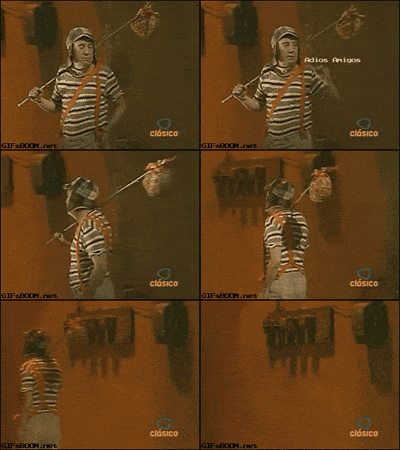
Phone cards, packing boxes, and El Chavo
My sense of humor didn’t just come from HBO stand-up or ABC Family sitcoms. It came from El Chavo del Ocho playing in the background of childhood, over and over, like a familiar song you don’t realize you’ve memorized. My dad used to call me “Chilindrina.” Not in a mean way. More like he had clocked something about me early — the dramatics, the commentary, the tendency to push things just a little too far and then smile like I didn’t know what happened. A lot of the time, my sister Sophia and I were very theatric together and when we would gather at the table together and she did something silly I would say “Sophia….” In a very sitcom-y way. Half warning, half disbelief, half trying not to laugh. The kind of delivery that assumes an invisible audience is watching. And then we’d both lose it.
I didn’t think of it as being funny. It just felt normal that small things could become big scenes, that people talked over each other, that feelings came out sideways. La Chilindrina wasn’t sweet or quiet or especially well-behaved. She was sharp. Watchful. A little chaotic. Being called that meant you were clever but also a handful.
When Bad Bunny brought El Chavo into an Saturday Night Live sketch, it hit something deeper than nostalgia. It reminded me how many of our parents had those tapes when they first came here. There weren’t many Spanish channels. You watched whatever you could find, whatever someone had recorded, whatever could be replayed until the tape wore thin. Those characters became familiar faces in a place where almost nothing else was.
I remember Rosetta Stone commercials playing constantly, promising that English could be learned like magic if you just repeated enough phrases. I remember going to the store to buy phone cards so someone could call home for a few precious minutes. Standing behind my grandma while the cashier slid them across the counter like they were something fragile while I asked for a dulce de leche or coco.
I remember packing boxes to send to family in Guatemala and El Salvador — clothes that didn’t fit anymore, snacks that wouldn’t melt, little things that felt important enough to tape up and ship across countries. We always sent my abuelita cases of Ensure. Then waiting weeks to hear that it arrived.
The show would be on during all of this. Not as the main event, just as company. Familiar voices filling the room. Laughter tracks that didn’t feel fake because someone in the house would usually laugh too.
People say I have “SNL energy,” but I don’t really watch SNL. If anything, my personality is more vecindad than stage. A lot of talking, a lot of reacting, a lot of turning awkward moments into something slightly ridiculous so they don’t feel so heavy. Humor not as performance, but as a way to keep things moving.. The idea that life is often illogical, disproportionate, impossible to resolve cleanly — and that you respond not with despair, but with a kind of stubborn humor. Think Albert Camus insisting on imagining Sisyphus happy, or one of his famous quotes that I reference often when things aren’t going my way; “Should I kill myself, or have a cup of coffee?” Not jokes for the sake of jokes, but comedy as a way to live inside uncertainty without being crushed by it.
Being “the Chilindrina” of the family didn’t mean being the funny one. It meant being expressive, alert, maybe a little too aware. The kid who notices everything and turns it into a story before it can turn into worry.
Seeing El Chavo pop up in a modern sketch didn’t feel random. It felt like someone briefly opened a door to a room many of us thought only existed in our own homes — a room with a flickering TV, half-packed boxes, adults speaking quickly in Spanish, and kids absorbing all of it without realizing it would stay with them.
Some things don’t leave you because they were important.
They stay because they were constant.
Sometimes your personality is just the echo of those rooms.
A flickering TV, a crowded table, your sister across from you, and you saying her name like the camera just zoomed in — keeping the story moving, even if no one knows where it’s going.
Even when everyone is gone.
Like the end of El Chavo del Ocho.